
DHI Hair Transplant Cost in Turkey: Price vs FUE (2026)
Last updated: October 2026
Short answer: In Turkey, DHI is sold the way almost everything is sold here: inside an all-inclusive package, and most clinics that offer it start between €1,290 and €3,000. Of the 100 clinics in our database, 89 offer DHI and 49 use it as their main technique. DHI is not automatically the expensive option: the DHI-led clinics that publish prices start at a median of €1,995 (about $2,250 or £1,700), below the €2,148 median for the whole market. Some clinics that sell both techniques list DHI in a higher package tier, so ask for both prices in writing. Our methodology explains how we collect and check these figures.
How much does a DHI hair transplant cost in Turkey?
Most Turkish clinics that offer DHI and publish prices start between €1,290 and €3,000 for a package: 52 of the 60 such clinics in our database fall in that range, with a median starting price of €2,198. Hardly any clinic publishes a separate per-graft DHI tariff; the technique sits inside the package, so you compare package prices, not graft rates.
| Database check (October 2026) | Clinics | Publish a price | Median starting price (€) | Starting prices (€) |
|---|---|---|---|---|
| Offer DHI | 89 of 100 | 60 | €2,198 | €1,290 – €4,300 |
| DHI is the main technique | 49 | 22 | €1,995 | €1,499 – €4,190 |
| DHI offered alongside other techniques | 40 | 38 | €2,325 | €1,290 – €4,300 |
| Do not offer DHI | 11 | 4 | €2,095 | €1,800 – €7,000 |
| All clinics | 100 | 64 | €2,148 | €1,290 – €7,000 |
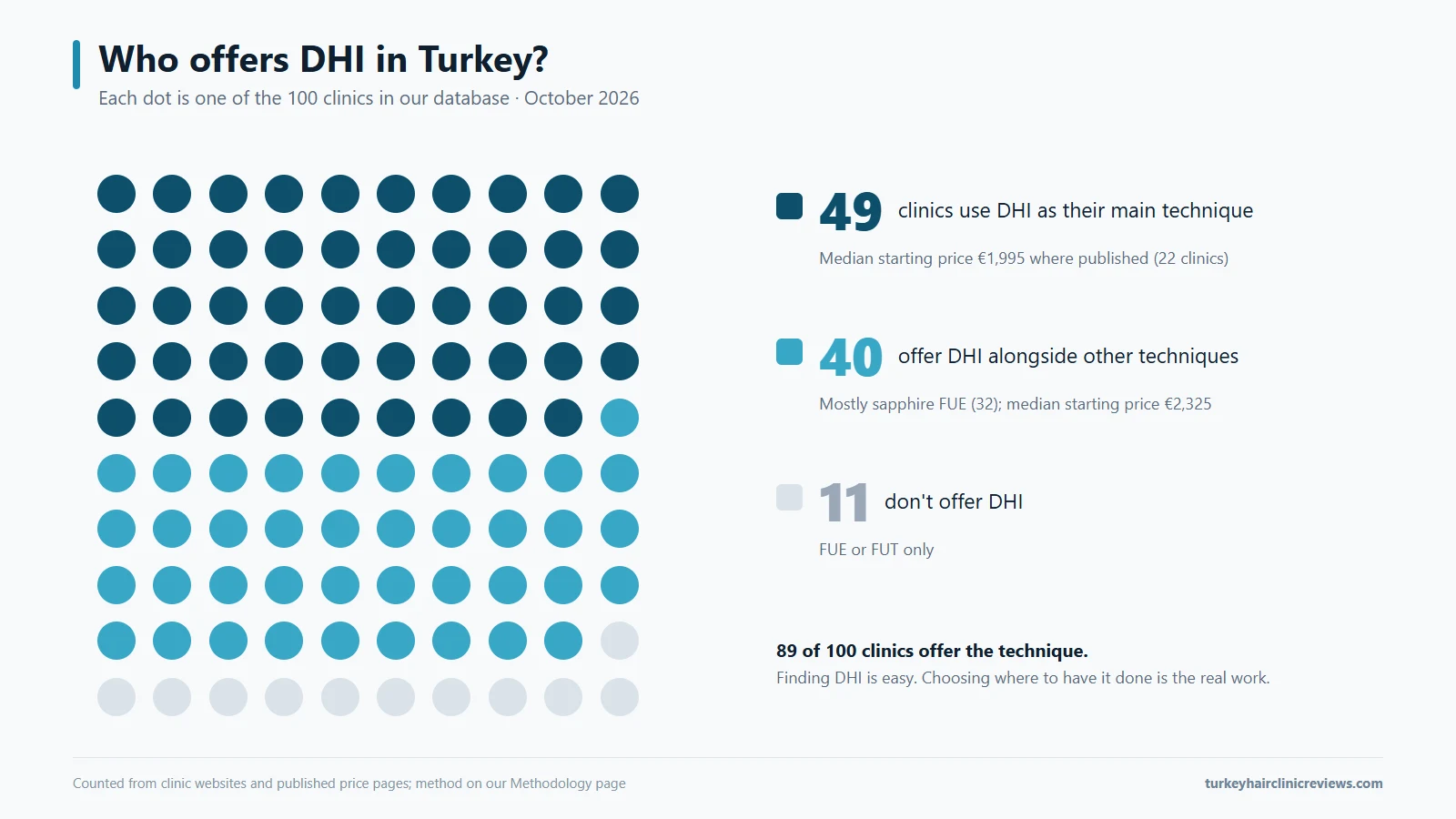
At the 49 clinics built around DHI, the price on the packages page is in practice a DHI price, flights excluded. The other 40 offer DHI next to another main technique, in 32 cases sapphire FUE. Only 22 of the 49 DHI-led clinics publish a price, so treat that median as an indication rather than a market rule.
All conversions on this page use the European Central Bank reference rate of 1 October 2026, when €1 was worth $1.13 and £0.85. The €2,148 market median is about $2,430 or £1,830, and €3,000 about $3,390 or £2,560.
Does DHI cost more than FUE in Turkey?
Inside a single clinic, sometimes; across the market, not clearly. Some clinics that sell both techniques put DHI in a higher package tier than their standard or sapphire FUE offer, while others price them the same. But clinics that lead with DHI are not pricier as a group: their median starting price (€1,995) is lower than that of clinics offering DHI as one option among several (€2,325).
Where a surcharge exists, it mostly pays for time and staff. An implanter pen carries one graft at a time and has to be reloaded after every placement, so DHI teams usually add assistants whose only job is loading pens; implanter guides describe exactly this kind of team system. A slower day with more people costs the clinic more, and that is what the higher tier covers. Before you compare offers, ask each clinic for its FUE and DHI prices for your graft count side by side, in writing.
What is DHI, and how is it different from FUE?
DHI, direct hair implantation, changes only the second half of the operation. Grafts are extracted exactly as in FUE, one follicular unit at a time with a small punch. The difference is placement: instead of opening all the recipient channels first and then inserting grafts with forceps, the surgeon or team uses an implanter pen whose hollow needle makes the incision and releases the graft in one motion.
The pen is not new. Korean surgeons Choi and Kim described the original implanter in 1992, for placing single hairs at the hairline and in eyebrows, eyelashes and beards. A 2024 review of graft placement techniques notes that implanters spread first in East Asia, where hair is often straight and thick, and gained ground in the West once FUE became common, partly because FUE grafts are more fragile and implanters handle them less.
| Step | DHI | Sapphire FUE |
|---|---|---|
| Extraction | Micromotor punch, graft by graft | Micromotor punch, graft by graft |
| Channel opening | No separate step; the pen makes the incision as it places the graft | Sapphire blade opens all channels first |
| Implantation | Implanter pen, one motion per graft | Forceps into pre-made channels |
| Shaving | Often avoidable on smaller cases | A full shave in most cases |
| Pace of the day | Slower, more staff per graft | Faster, suits large sessions |
| Where the price sits | Same package or a higher tier, depending on the clinic | Same package or a lower tier, depending on the clinic |
Does the pen grow more hair? Not by itself. Clinics often argue that DHI shortens the time grafts spend outside the body, and that time does matter: survival data quoted by Sethi and Bansal show about 95% of grafts surviving 2 hours in chilled saline and 90% at 4 hours. But a short out-of-body time depends on how the team organises the day, not on the pen; Sethi and Bansal's own fast protocol used blade-made sites and forceps. We found no large head-to-head trial showing better growth with the pen. A careful FUE team will beat a careless DHI team every time. Where the pen earns its reputation is control: fine work at the hairline, tight packing in a small zone, and placement between existing hair without shaving. Our FUE vs DHI comparison and our DHI treatment page go into the clinical detail.
Who holds the DHI pen: the doctor or a technician?
Ask, because in DHI the answer tells you who is making your incisions. The International Society of Hair Restoration Surgery says surgery execution, including donor harvesting, hairline design and recipient site creation, belongs to a licensed physician, and advises patients to ask whether anyone unlicensed will be making incisions or harvesting grafts. With FUE, the doctor can open every channel and trained technicians then place grafts into them. With a sharp implanter, the incision and the placement happen in the same motion, so whoever holds the pen is also creating the recipient sites.
In practice, many Turkish clinics hand the pen to technicians, and we could confirm a doctor-led procedure at only 37 of the 100 clinics in our database; the doctor-led filter in Compare all clinics shows which ones. That is not automatically a reason to walk away, but you should know before you pay. Ask plainly: who extracts, who holds the pen, and who designs and checks the hairline, by name. Our guide on whether a hair transplant in Turkey is safe lists the other red flags.
What does a Turkish DHI package include?
At most clinics, nearly everything except your flight: the operation, hotel nights, airport and clinic transfers, medication, the first washes and aftercare products. That bundle applies to DHI exactly as it does to FUE, and it is why a trip to Istanbul usually undercuts a per-graft quote at home.
The bundle is not universal, though. Among the 100 clinics in our database, 68 include the hotel, 73 include transfers and 77 include structured aftercare; 59 include all three, and 27 include neither hotel nor transfers. Our Transparency Index checked 96 clinics for written price inclusions: 58 put them in writing and 38 did not. Before any deposit leaves your account, get the inclusion list as a document, and ask in the same email whether unshaven DHI costs extra at that clinic, because some charge for it. Our guide to hair transplant packages lists what is usually left out.
Is DHI worth the extra money?
For the right case, yes; for the wrong one, the surcharge mostly buys a label. DHI makes sense when precision decides the result: a hairline people will look at closely, density packed into one limited zone, long hair the patient does not want to shave, and many female cases where shaving is not an option.
A Norwood 6 who needs 4,000 to 6,000 grafts over a large area is buying coverage, not precision, and coverage is where FUE's faster pace helps. Many surgeons combine the two on big cases: FUE for the mid-scalp and crown, the pen for the hairline. If a clinic insists on an expensive all-DHI plan for a very large area and cannot explain why, take your time before signing. Our guide on how many grafts you need shows the typical range for each Norwood stage.
Where you have it done matters more than the technique label. You can see which clinics lead with DHI in Compare all clinics, or start from our ranking of the best hair transplant clinics in Turkey.
Sources:
- Clinic, technique and price figures: our own database of 100 Turkish hair transplant clinics, last checked in October 2026; the methodology explains how the data is collected and checked.
- Choi YC, Kim JC. Single hair transplantation using the Choi hair transplanter. J Dermatol Surg Oncol. 1992;18(11):945-948.
- Speranzini M, Souza SEG. Advancements in graft placement techniques. Facial Plast Surg. 2024;40(2):223-233.
- Park JH, Ho YH, Manonukul K. A practical guide to hair graft placement using the sharp implanter method. Clin Cosmet Investig Dermatol. 2023;16:1777-1785.
- Sethi P, Bansal A. Direct hair transplantation: a modified follicular unit extraction technique. J Cutan Aesthet Surg. 2013;6(2):100-105.
- International Society of Hair Restoration Surgery, "Beware of unlicensed technicians performing hair restoration surgery" (January 2024).
- Wimpole Clinic, UK hair transplant cost analysis: quotes from 104 UK clinics, average £3.25 per graft.
- European Central Bank, euro reference exchange rates of 1 October 2026: €1 = $1.1298 = £0.85373.
FAQ
Why is DHI so much cheaper in Turkey than in the UK or Germany?
Billing and costs. UK and German clinics mostly charge per graft, so more grafts mean a bigger bill (the UK average in a 104-clinic quote study was £3.25 per graft), and they pay Western salaries. Turkish clinics sell packages and run enough procedures to make lower prices work. Our country price comparison has the numbers for the UK, the USA and Germany.
Does unshaven DHI cost extra?
Sometimes. Placing grafts between existing hair slows an already slow technique, and clinics handle that cost differently: some quote a higher price for unshaven work, others include it in the standard DHI package. Ask before you book and get the answer in your written inclusion list.
Does DHI use fewer grafts than FUE?
No. The graft count comes from your pattern of hair loss and your donor area, not from the tool. A graft is one follicular unit whether it is placed with a pen or with forceps. What the tool changes is how many grafts fit comfortably into one day, and the pen is the slower option.
Can DHI handle a big session?
Up to a point. Some clinics spread a large DHI case over two days; others suggest the pen for the hairline and FUE for the rest, which many respected surgeons do. Either suggestion is a sensible answer to a slow tool, not a warning sign.

Laura Whitfield
Writes the clinic comparisons and guides for Turkey Hair Clinic Reviews. Every ranking follows our published methodology, and every price is checked against what the clinic itself publishes.