
Is a Hair Transplant in Turkey Safe? 8 Red Flags (2026)
Last updated: September 2026
Quick answer: Yes, hair transplant in Turkey is safe as long as the clinic is authentic and run by a physician. The risk is in a gray area where the sales pitch is more important than the surgeon. Based on our database of the 100 clinics we review, the safe side of this market is not hard to spot once you know which documents to demand. Our Methodology shows how every profile is compiled.
Is a hair transplant in Turkey safe?
Yes. Book a licensed facility where the surgeon has a name and a face, and the procedure itself carries the same medical risks as anywhere else. Turkey is one of the world's largest hair transplant markets. The catch: the same market shelters operators nobody licensed, so the risk comes from which door you pick, not from the country.
The regulatory framework is real. Performing this surgery requires a facility license from the Ministry of Health. Serving patients from abroad takes a second document, the International Health Tourism Authorization Certificate. Doctors in private practice must be registered with the Turkish Medical Association. The system works. It just doesn't stop everybody. The volume tells both stories at the same time. Istanbul alone hosts hundreds of clinics. Some of the most practiced transplant surgeons anywhere operate here. So do operators running a sales office with a rented operating room. Both advertise on the same platforms, often at similar prices. The rest of this guide is about telling them apart.
Why do things go wrong in some Turkish clinics?
Many of the bad outcomes patients report are not rare surgical complications. They trace back to how the surgery is organized and how many patients a clinic pushes through per day. When no doctor plans the case, opens the channels, or supervises the team, or when a team runs eight cases a day, quality control disappears. In our database, only 37 of the 100 clinics state on their own website that a named doctor personally performs the procedure.
Technician involvement itself is not the problem. Inside a licensed Turkish clinic the split usually runs like this: the doctor examines the patient, designs the hairline, opens the channels, and controls every stage, while technicians the doctor trained carry out extraction and implantation under a watching eye. This division of labor is normal. The rogue version looks different, and the International Society of Hair Restoration Surgery has spent years warning about it. A doctor's name appears on the license, that doctor greets you for five minutes, and afterward no physician touches the plan, the channels, or the oversight. At high volume, oversight can shrink to a single doctor listed across multiple rooms at the same time.
The second driver is donor depletion. Nature puts a ceiling on how many grafts any donor zone can give up. Clinics that sell "maximum grafts" packages strip past that ceiling. The result shows up a year later: a thinned, patchy donor area that no future procedure can fix.
None of this means Turkish clinics are worse than clinics elsewhere. It means the volume model creates a specific failure mode, and you can screen for it before booking.
What are the real medical risks?
Four outcomes make the serious list: infection, skin necrosis, permanent damage in the donor zone, and an unnatural hairline. Each stays rare where licensing is real, and each links back to technique or hygiene, not to the procedure itself. Some effects that alarm patients are actually normal.
Normal and expected:
- Forehead swelling that settles within days
- One to two weeks of scabbing and redness where the grafts sit
- Shock loss, a shedding phase hitting transplanted and nearby native hairs around weeks two to eight, followed by regrowth
- Numbness around either zone that fades on its own
Warning signs of a problem:
- Pain, heat, or discharge that climbs after the first days, pointing to infection
- Tissue darkening where grafts were placed, an early necrosis signal
- A donor zone that heals visibly thin or moth-eaten, the mark of overharvesting
- A hairline placed too low or too straight, which cannot be undone without further surgery
Any licensed clinic handles the first list as routine, with antibiotics and a standard care plan. The second list is decided by where you booked. Infection follows hygiene discipline. Necrosis follows anesthetic technique and how densely the grafts were packed. Donor damage and bad hairlines track who planned and performed the surgery.
What are the red flags when choosing a clinic in Turkey?
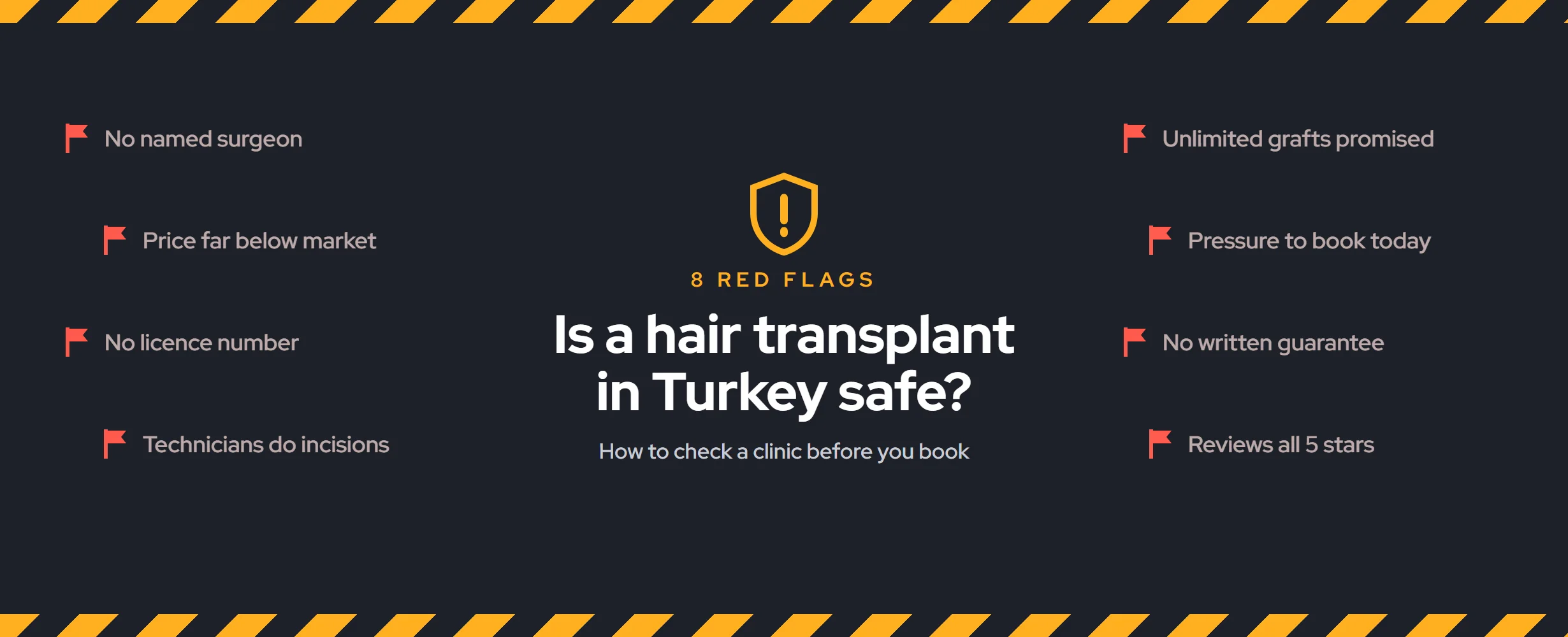
The loudest warning signs: a surgeon nobody names, a price far below every other offer, graft promises with no ceiling, and pressure to book. Any one of them alone is a reason to slow down. Two or more together is a reason to walk away.
| Red flag | Why it is risky | What to ask |
|---|---|---|
| No named doctor on the website | Suggests physician planning and oversight are missing | By name, who does the extraction and who does the implantation? |
| A price far below other offers AND no named doctor | Low price alone is not a warning sign (some respected doctor-led clinics start near €1,000), but a bargain with no named surgeon usually means costs were cut on staff or hygiene | Who performs the surgery, by name, and what exactly is excluded from this price? |
| "Unlimited grafts" or "maximum grafts" offers | Incentive to overharvest your donor area | How many grafts does my donor area safely allow? |
| Guaranteed density or a written success rate | No surgeon can guarantee biological outcomes | Can I see healed results at 12 months for cases like mine? |
| Diagnosis from two phone photos on WhatsApp | Setting a graft count and a hairline takes a proper assessment | Before I pay, can the doctor see me on a video call? |
| A discount that dies unless the deposit lands today | Sales tactic to prevent comparison | Does the quote stay valid for 30 days? |
| Reviews only on the clinic's own site | Independent review history may be poor or absent | Where can I read your Trustpilot and Google reviews? |
| Vague answers about daily patient volume | High volume per team means less doctor time per patient | How many surgeries does my surgical team do per day? |
One caution on the other direction. A high price is not proof of quality. Some heavily marketed clinics charge premium rates and still run a technician-led volume model. Price screens out the bottom. It doesn't certify the top.
How to check if a Turkish clinic is licensed?
Ask for the clinic's Ministry of Health facility license and the International Health Tourism Authorization Certificate. Then check the doctor's registration with the Turkish Medical Association. A legitimate clinic will send you these documents within a day. If they don't or refuse, that's the end of the conversation.
Step by step:
- Ask for the facility license. No medical facility operates in Turkey without a Ministry of Health (Sağlık Bakanlığı) license. Ask for it, then match the legal entity name on it to the clinic you are working with. Many clinics operate under a different brand name than the licensed entity, which is normal, but the clinic should be able to prove the link.
- Check the health tourism authorization. The International Health Tourism Authorization Certificate (Uluslararası Sağlık Turizmi Yetki Belgesi) is the second requirement for treating patients from abroad. The Ministry of Health keeps a public list of authorized facilities. Advertising abroad while missing from that list calls for an explanation.
- Verify the doctor. Ask for the surgeon's full name and confirm registration with the Turkish Medical Association (Türk Tabipleri Birliği). Ask about specialty too. Surgeons in this field often come out of dermatology or plastic surgery.
- Match the marketing to the license. The doctor on the website should be the doctor on the consent form you sign on surgery day. If a different name appears, stop and ask.
- Cross-check independent reviews. Read the clinic's recent Trustpilot and Google pages, skipping the testimonials it curates on its own site. The useful entries land 6 to 12 months after surgery, once real results show.
Our clinic profiles record the named doctors, published prices and current review scores for the 100 clinics we review, and note licence information where the clinic publishes it. The Methodology page lays out the checks behind each item.
How much does a safe hair transplant in Turkey cost?
In our database of 100 clinics, published hair transplant prices start from €1,290, the median is about €2,150, and most packages top out below €7,000. What matters more than the headline price is what it leaves out: staff qualifications, sterilization and aftercare.
| Price point | € | ~$ | ~£ |
|---|---|---|---|
| Lowest published starting price | €1,000 | $1,150 | £850 |
| Median starting price | €2,150 | $2,500 | £1,850 |
| Most packages top out below | €7,000 | $8,050 | £5,950 |
Rates: September 2026.
What moves a clinic up or down inside that range: the surgeon's share of the work and name value, which technique is used, where sapphire FUE and DHI carry higher tags than standard FUE, the number of grafts, and whatever rides along in the package: hotel, transfers, PRP sessions.
The cost logic loops back to the warning signs. A day in a licensed operating room, a full team, instruments opened fresh for each patient, and months of follow-up contact all cost money. That has a real cost floor. An operator quoting far below it is not being generous. It is skipping something.
What should a legitimate package include?
Five things sit inside a legitimate package: a doctor-led consultation, blood work before surgery, the surgery with a surgeon whose name you know present in the room, medications, and aftercare that actually follows up. Hotel and transfers come standard in the Turkish market. The hotel does not separate reliable from suspect. The medicine inside the package does.
| Item | In a reliable package | In a suspect package |
|---|---|---|
| Consultation | You meet the doctor first, video or in person, then money moves | Photo review by a sales rep on WhatsApp |
| Blood tests | Done before surgery, results reviewed | Skipped or not mentioned |
| Who operates | The lead surgeon is named; every team role gets explained | "Our expert team" with no names |
| Graft count | Set by donor capacity, stated as a realistic range | "Unlimited" or a round number promised upfront |
| Anesthesia and hygiene | Explained openly, single-use instruments | No information offered |
| Medications | Post-op antibiotics and care kit included | Sold separately after surgery |
| Aftercare | A written care plan, first wash done at the clinic, photos tracked to month 12 | "Text us if anything happens" |
| Interpreter | With you from first assessment through surgery day and recovery | Present until you pay, then gone |
| Hotel and transfers | Included and specified | Included, and the only part of the package described in detail |
| Contract | Written agreement naming the procedure, surgeon, and price | Verbal promises, no invoice or receipt |
A note on payment. Paying at the clinic on surgery day is standard in Turkey, and many patients prefer it to sending money abroad in advance. A small deposit to hold a date is also normal. The warning sign is the paperwork, not the timing: no invoice, no receipt, and no written agreement to sign.
What questions should you ask before booking?
Five questions decide most of what matters: who performs the extraction and implantation by name, whether you can speak with the doctor on video before paying, how many grafts your donor zone can give without damage, how many cases the team takes per day, and what aftercare looks like after you fly home. Our full checklist of 20 questions to ask a hair transplant clinic covers the rest.
The Bottom Line
A hair transplant in Turkey is safe where three things line up: a real license, a surgeon you can name, and aftercare that picks up when you call. That combination exists at scale here. The risk is real but identifiable: no doctor's name, an impossible price, unlimited grafts, and pressure to pay today. Check the license, check the doctor, and get each promise on paper.
Where to go next:
- Best Hair Transplant Clinics in Turkey 2026 for our current ranking
- Compare All Clinics to filter the 100 clinics we review by city, price, and technique
- Methodology for how we compile doctor, price, and review data
- How to Choose a Hair Transplant Clinic in Turkey for the full selection guide
Prices in this article are checked every 6 months. Last price update: September 2026.
FAQ
Is it safe to have a hair transplant in Istanbul if the clinic only communicates through WhatsApp and never offers a video call with a doctor?
No. WhatsApp is a normal channel in Turkey, and most clinics use it. The problem starts when a sales rep on WhatsApp is the only assessment you ever receive. If a doctor never appears before payment, assume a doctor is not central to the operation.
Is it safe to book a hair transplant in Turkey through an agency instead of directly with the clinic?
It can be, but the agency adds a layer between you and the medical team. Run the same checks on the underlying clinic and surgeon as with a direct booking. An agency keeping the clinic anonymous until your deposit clears should not get that deposit.
Which is safer in Turkey, FUE or DHI?
Neither technique is inherently safer; our FUE vs DHI comparison explains how they differ. Both are minimally invasive when performed correctly. Outcomes track the team, not the tool. A skilled team gets good results with either. A poor team gets bad results with the most expensive implanter pen on the market.
What happens if something goes wrong after I fly home from Turkey?
Minor issues get sorted remotely, photos plus a prescription written by a doctor near you. A serious complication gets treated in your home country, and chasing the clinic afterward across a border is hard. This is why the aftercare question belongs in your pre-booking checklist, not in your post-surgery panic.
Is it safe to combine a hair transplant in Turkey with a holiday?
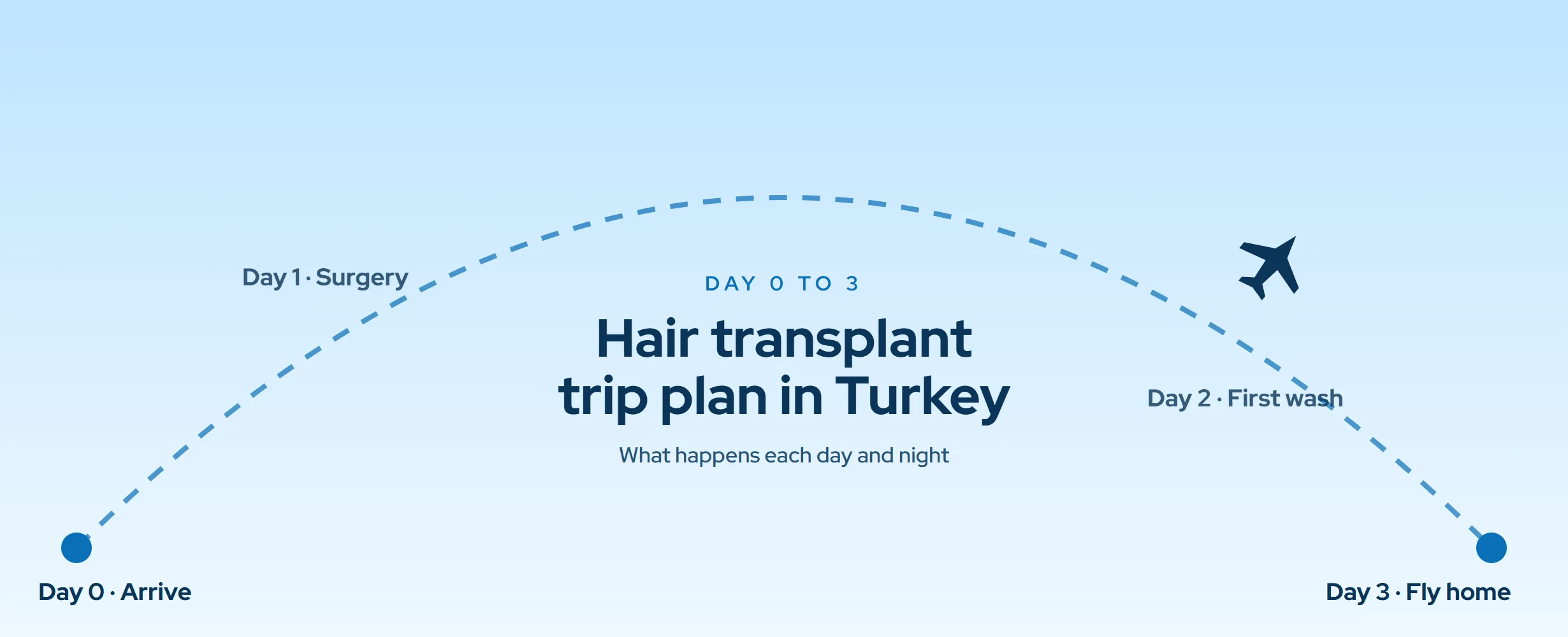
Partly. Plan the trip around the surgery, not the other way. No swimming, sea, sauna, or direct sun on the scalp for at least two weeks, and no alcohol immediately before and after the procedure. A quiet three or four day stay with the first wash done at the clinic is the sensible version.

Laura Whitfield
Writes the clinic comparisons and guides for Turkey Hair Clinic Reviews. Every ranking follows our published methodology, and every price is checked against what the clinic itself publishes.
