
Hair Transplant in Turkey: Trip Plan, Day 0 to 3 (2026)
Last updated: September 2026
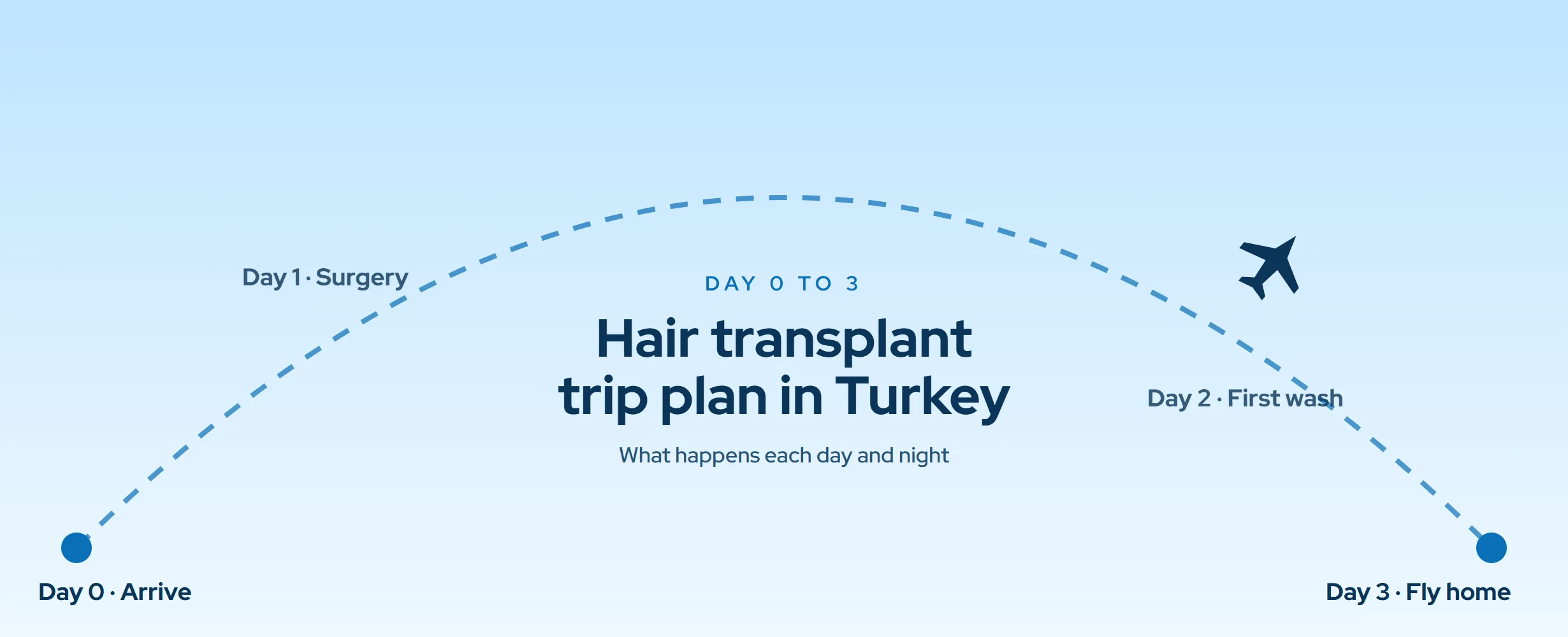
Quick answer: A hair transplant trip to Turkey takes 3 days and 2 nights at the bare minimum, and 3 to 4 nights for comfort. You arrive and have the consultation on Day 0, have surgery on Day 1, rest and get a check-up on Day 2, then learn the first wash and get cleared to fly on Day 3. On the minimum plan the check, the wash and the flight all fall on Day 2. This plan covers what happens at each step and what varies between clinics. Our Methodology explains how we compile clinic data.
| Day | What happens | Where | What varies between clinics |
|---|---|---|---|
| Day 0 | Airport pickup, hotel check-in, in-person consultation, hairline drawing, paperwork | Airport, hotel, clinic | Consultation the evening you land or on surgery morning |
| Day 1 | Surgery, 6 to 8 hours: anesthesia, extraction, implantation, dressing | Clinic | Who extracts and implants, and how many surgeries the team runs that day |
| Day 2 | Rest, bandage check or removal | Hotel, clinic or video call | In-person check or a photo review on WhatsApp |
| Day 3 | First wash, final photos, clearance to fly, airport transfer | Clinic, airport | Wash done hands-on or only shown on video |
Your clinic's written instructions take priority over these general timelines.
How many days do you need for a hair transplant in Turkey?
The bare minimum is 3 days and 2 nights: consultation on the day you land, surgery on Day 1, then the check, the first wash and the flight squeezed into Day 2. It works for straightforward cases. Three nights spreads those last steps over separate days, and four adds a buffer for flight changes. A consultation on surgery morning is normal, because by then the plan already exists: the doctor has seen your photos, agreed a graft range and discussed expectations online before you booked the flight. The in-person exam confirms that plan rather than starting from zero.
| Stay (days / nights) | Who it fits |
|---|---|
| 3 days / 2 nights | The bare minimum: straightforward cases, tight schedules, everything on Day 2 goes right |
| 4 days / 3 nights | The standard plan, with the wash and the flight on separate days |
| 5+ days / 4+ nights | Larger sessions, a second check-up, nervous flyers |
A longer stay buys margin, not better grafts. The surgical result is set on Day 1. Extra nights only make the recovery calmer and the timeline less fragile.
Day 0: What happens when you arrive?
Day 0 is logistics plus the one meeting that matters. A driver meets you at the airport, drops you at the hotel, and the clinic confirms your consultation slot. Wear or pack a button-up shirt. Nothing goes over your head after surgery.
What happens at the consultation?
The in-person consultation confirms what was agreed online: the doctor examines your scalp and donor area, finalizes the graft range, draws the hairline on your head, and you sign the paperwork. Blood tests are taken now or on surgery morning. Payment terms are settled here too. Paying at the clinic is standard in Turkey, and a small deposit beforehand is normal.
What should you stop before you arrive?
Alcohol and smoking go on pause before surgery, and blood thinners need your own doctor's sign-off well ahead of the trip, usually 7 to 10 days. Every serious clinic sends a pre-op list. If yours never does, that silence is information.
Where clinics differ on Day 0:
- Some hold the in-person consultation the evening you land, others on surgery morning. Both are normal, because the real assessment happens online before you fly: photos, a graft range, the hairline discussion and the price. What matters is that this pre-trip assessment happened at all. If nobody looked at your case before you booked, the morning consult carries too much weight.
- Hotel and transfers are bundled at most clinics, but the hotel's distance to the clinic varies a lot. A 40 minute ride on wash day gets old.
- A few clinics run the hairline discussion with the doctor on video before you ever fly. That is a good sign, not a shortcut.
Day 1: What happens on surgery day?
Surgery day runs 6 to 8 hours for a typical session, most of it lying down and surprisingly boring. The table shows the standard flow and where practice differs from clinic to clinic.
| Stage | Standard flow | What varies between clinics |
|---|---|---|
| Arrival and prep | Morning check-in, final photos, head shave | Start time varies with the clinic's schedule. Confirm yours and the pickup hour the evening before |
| Hairline confirmation | The doctor re-draws and confirms the line with you in a mirror | Whether the doctor is present at all. In our database, only 37 of the 100 clinics state that a named doctor personally performs the procedure |
| Local anesthesia | Injections in the donor area, the one uncomfortable part | Some clinics use needle-free pressure devices to take the sting out |
| Extraction | Grafts taken one by one, 2 to 4 hours | Who extracts: the doctor, or technicians working under the doctor's supervision |
| Break | Lunch at the clinic | Length. A very short break signals a rushed schedule |
| Channels and implantation | The doctor opens channels, the team implants | Sapphire FUE or DHI changes the tools more than the timeline |
| Dressing and discharge | Bandage on the donor, care kit, medications, written instructions | Whether instructions come on paper or as a hallway speech. Ask for paper |
Does the surgery hurt?
The anesthesia injections sting for a minute, then the day is numb. Expect pressure and sounds, not pain. The first night you sleep on your back, propped at roughly 45 degrees, with the travel pillow you packed.
Before you book, ask one thing about Day 1: how many surgeries your team runs that day. One or two is the right answer. Our list of 20 questions to ask a hair transplant clinic covers the rest.
Day 2: What can you do the day after surgery?
Day 2 belongs to your scalp, not to Istanbul. Most clinics remove or check the donor bandage today, in person or over video. Walking is fine. Sweat, sun, alcohol, and anything that risks a bump to the head are not.
Can you go out on Day 2?
Yes, gently. A shaded cafe or a slow waterfront walk works. Crowded bazaars, hamams, pools and the sea do not, and the two week no-sun rule starts now, not when you land home. If you want the trip to double as a holiday, plan the tourist part before surgery, not after. The safety side of that trade-off is covered in our guide on whether a hair transplant in Turkey is safe.
Where clinics differ on Day 2:
- Some schedule an in-person check, others a WhatsApp photo review. Both can work; know which one you are getting.
- Painkiller and antibiotic protocols differ. Your Day 1 care kit should already cover Day 2 without a pharmacy run.
Day 3: When can you fly home?
Day 3 has two jobs: learn the wash, get cleared to fly. At the clinic, a nurse washes your head with foam and lotion, slowly, and teaches you the exact motion you will repeat daily for the next two weeks. Then come the final photos and the flight clearance.
When can you fly after a hair transplant?
Most patients fly 48 to 72 hours after surgery, once the clinic confirms healing looks normal. Book a window seat, bring the neck pillow, keep the headrest off your grafts, and drink more water than you want. Cabin air dries the scalp.
Where clinics differ on Day 3:
- The first wash is done hands-on at some clinics and only shown on video at others. Ask which before booking. Hands-on teaching is worth more than a link.
- Aftercare contact after you fly ranges from a scheduled 12 month photo plan to "message us if something happens." The difference shows exactly when you need it.
What should you pack for a hair transplant trip?
- Button-up or zip-front shirts, enough for every day
- A U-shaped travel pillow, for the flight home and the first nights
- Your regular medications, plus a list of them in English
- A passport valid for at least 6 months, and whatever visa your nationality needs
- Comfortable slip-on shoes, since bending over a shoelace is unpleasant the day after surgery
- A power bank. Surgery day is long and your phone is the entertainment
The clinic package usually covers the hotel, transfers and the care kit. One thing to leave out of the suitcase: hats. Nothing tight should touch the grafts for at least 10 days, and loose hood-style caps only when the clinic approves them.
The Bottom Line
The trip itself is the easy part: 3 to 4 nights, one long day in a chair, two calm days around it. What separates a good trip from a bad one is decided before you fly, in which clinic you picked and what you confirmed in writing. The plan above tells you what to expect. How to Choose a Hair Transplant Clinic in Turkey tells you how to pick, Best Hair Transplant Clinics in Turkey 2026 shows our current ranking, and Compare All Clinics filters the 100 clinics we review by city, price and technique.
FAQ
Is 3 days enough for a hair transplant in Turkey?
Yes. The 2 night version fits a consultation on arrival, surgery on Day 1, and the check, first wash and flight on Day 2. It works when everything runs on time and leaves zero buffer, so a delayed flight or a heavy session turns tight fast. One extra hotel night removes that risk.
Can I travel alone for a hair transplant in Turkey?
Yes, and most patients do. Transfers are driven, the surgery uses local anesthesia only, and you walk out of the clinic on your own feet. Company helps more on the flight home than at the clinic.
Do I need to book my own hotel and airport transfers, or does the clinic arrange them?
At most clinics both sit inside the package. Confirm the hotel name and its distance to the clinic before paying, and get the pickup arrangement in writing, including the return airport run on Day 3.
Can I go back to work right after flying home?
Desk work, usually within 2 to 3 days of landing, redness and scabs included. Physical work waits 10 to 14 days. Video calls are fine, though many patients keep the camera off for the first week while redness and scabs are visible.
What documents do I need to travel to Turkey for a hair transplant?
A passport with at least 6 months validity, any visa your nationality requires, your booking confirmation, and the clinic's appointment letter in case your airline or a border officer asks about the visit. Keep your medication list and the signed treatment agreement in your hand luggage for the trip home.

Elif Yıldırım
Covers the patient side of a hair transplant in Turkey: recovery, aftercare and the questions worth asking a clinic before booking. Fact-checks each article against our clinic database.