

How Many Grafts Do I Need? Norwood Scale Guide & Cost (2026)
Last updated: October 2026
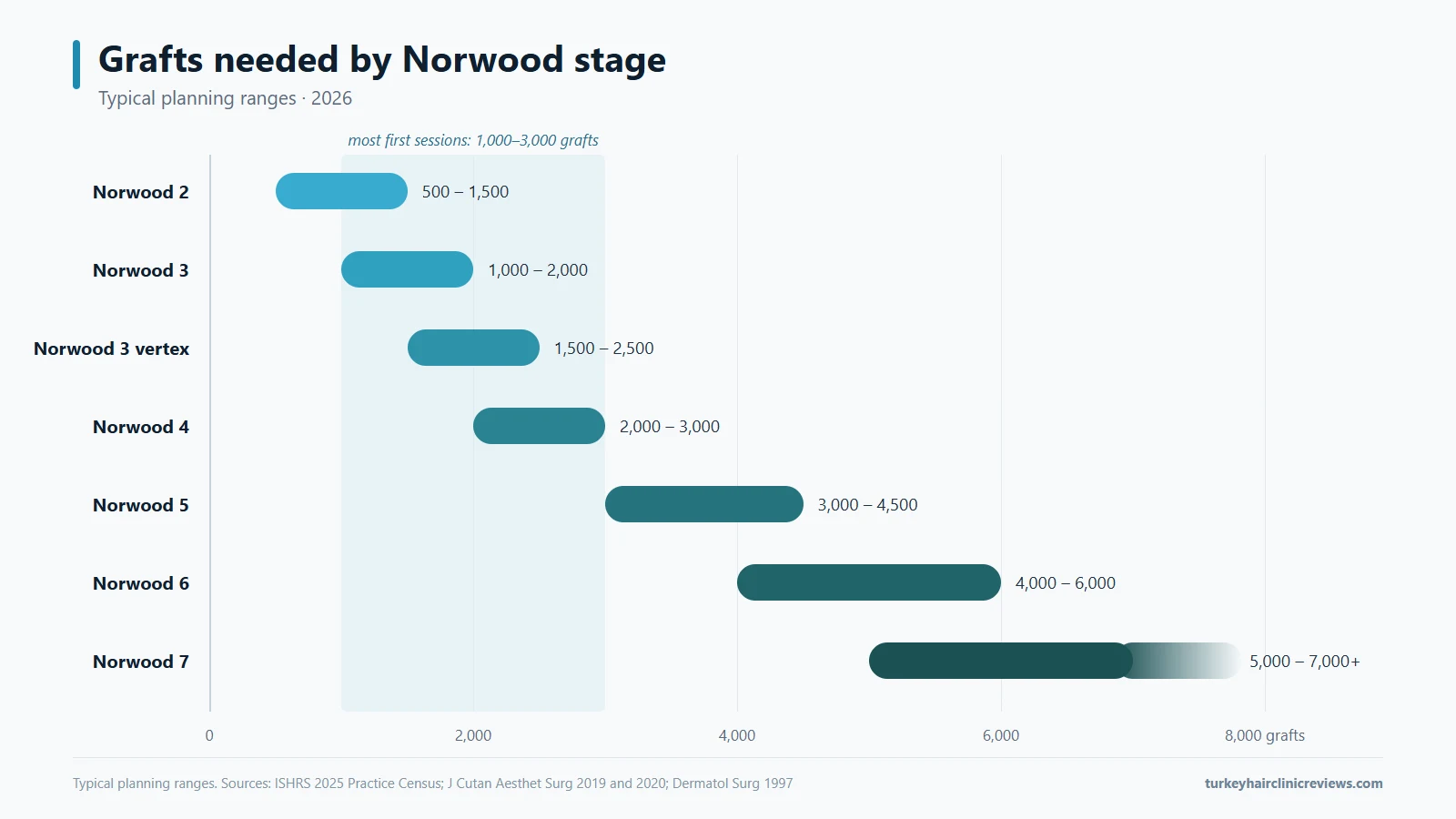
Short answer: Most first hair transplants use 1,000 to 3,000 grafts; ISHRS member surgeons reported an average of 2,347 grafts for a first procedure in 2024. As a rough guide, Norwood 2 needs 500 to 1,500 grafts, Norwood 3 needs 1,000 to 2,000, Norwood 4 needs 2,000 to 3,000 and Norwood 5 needs 3,000 to 4,500. Norwood 6 and 7 need 4,000 to 7,000 or more, usually over two sessions, because the donor area runs out before the bald area is covered. Price is the simpler part in Turkey: most clinics sell packages rather than charging per graft, and across the 64 clinics in our database that publish prices, the median starting package is €2,148 (about $2,430 or £1,830). Our methodology explains how we collect and check that data.
How many grafts does each Norwood stage need?
Roughly 500 to 1,500 grafts for Norwood 2, 1,000 to 2,000 for Norwood 3, 2,000 to 3,000 for Norwood 4, 3,000 to 4,500 for Norwood 5, 4,000 to 6,000 for Norwood 6 and 5,000 to 7,000 or more for Norwood 7. The crown decides most of it: front only stays under about 2,000, front plus an opening crown moves toward 3,000, and once front and crown merge into one bald zone you are past 4,000.
| Norwood stage | Loss pattern | Typical grafts | Sessions | Cost in Turkey (€) |
|---|---|---|---|---|
| Norwood 2 | Temples creep back, hairline otherwise intact | 500 – 1,500 | 1 | One package: from €1,290, median €2,148 |
| Norwood 3 | Deep recession at both temples | 1,000 – 2,000 | 1 | One package, around the €2,148 median |
| Norwood 3 vertex | Stage 3 front plus a bald spot on the crown | 1,500 – 2,500 | 1 | One package, around €2,148 |
| Norwood 4 | Front and crown both thinning, a band of hair still between them | 2,000 – 3,000 | 1 | One package, €2,148 and up |
| Norwood 5 | The band between front and crown thins out | 3,000 – 4,500 | 1 large session | €2,148 and up; larger cases often sit in a clinic's upper price tier |
| Norwood 6 | Band gone, front and crown form one bald zone | 4,000 – 6,000 | 1 – 2 | About €2,148 – €4,300 |
| Norwood 7 | Only a low horseshoe of hair left at the sides and back | 5,000 – 7,000+ | Usually 2 | About €4,300 for two packages, plus a second trip |
All conversions on this page use the European Central Bank reference rate of 1 October 2026, when €1 was worth $1.13 and £0.85. The €2,148 median is about $2,430 or £1,830, the €1,290 entry price about $1,460 or £1,100, and two median packages (€4,300) about $4,850 or £3,670.
Where do these graft numbers come from?
No single study maps every Norwood stage to a graft count, so the table combines three kinds of evidence: what surgeons actually do in an average first session, what published case series used for advanced loss, and how much hair the donor area can give.
The average comes from the International Society of Hair Restoration Surgery. In its 2025 Practice Census, covering 2024, member surgeons reported 2,347 grafts on average for a first procedure and 1,637 for a later one. More than half (58.4%) said a typical first session used 1,000 to 1,999 grafts, and only 2.2% said their typical FUE case went past 4,000. That is where the early-stage rows sit.
For advanced loss, the largest dataset we found is a 2019 review of 820 FUE patients, all Norwood 5 to 7, in the Journal of Cutaneous and Aesthetic Surgery. The authors planned grafts by the area being covered:
- Frontal forelock only: at least 1,500 to 2,000 grafts
- Front only: 3,000 to 3,500 grafts
- Front plus mid-scalp: 4,500 to 5,000 grafts
- The whole bald area: at least 6,000 grafts
A second paper in the same journal (2020) planned higher, because its surgeons added beard and chest hair to the scalp grafts: 2,500 to 3,000 grafts for Norwood 4, 4,000 to 5,000 for Norwood 5, 6,000 to 7,000 for Norwood 6, and 7,000 to 8,000 for Norwood 7, the last always over several sessions. It was a small study of 16 patients, and most people have neither the body hair nor the wish for that approach, which is why our table sits lower.
The donor area sets the ceiling. In their 1997 surgical planning paper, Bernstein and Rassman wrote that in a Norwood 6 or 7 pattern the area that needs hair exceeds the total donor supply by a factor of at least 6 to 1, so only light to moderate coverage is possible in one session. The 2020 paper did the same arithmetic in grafts: a safe scalp donor area holds about 12,500 grafts, around 6,000 can be taken safely, and a full Norwood 7 would need about 9,000. Good surgeons spend the supply where the face needs it, hairline and front first, and say early if the crown will stay thin.
How do I find my Norwood stage?
Compare clear, dry-hair photos of your hairline and crown, taken in daylight, with the seven stages below; a doctor's scalp exam confirms it. Avoid judging from the bathroom mirror after a shower, because wet hair clumps and shows more scalp than you really have.
- Stage 1: A full hairline with no recession. Nothing for a surgeon to do.
- Stage 2: Slight recession at the temples. Many doctors see this as a mature hairline rather than balding.
- Stage 3: Both temples have receded deeply. Norwood set this as the first stage that counts as balding. In the "3 vertex" variant, the crown thins at the same time.
- Stage 4: The front keeps receding and the crown spot grows, but a band of hair still separates them.
- Stage 5: That band narrows and starts to thin.
- Stage 6: The band is gone; front and crown form one bald zone.
- Stage 7: Only a low horseshoe of hair remains, from above one ear, around the back, to above the other.
The scale dates from 1975, when Dr O'Tar Norwood revised James Hamilton's earlier classification, and consultation forms still use it. A stage describes area, though, not the plan: two men at the same stage can need quite different graft counts, for the reasons below.
How many grafts do I need for Norwood 3?
Most Norwood 3 plans use 1,000 to 2,000 grafts. Filling the temple corners can take about 1,000; rebuilding the whole frontal hairline with density behind it tends to take closer to 2,000. Grafts are not hairs: a graft is a follicular unit of one to four hairs, and in the 820-case study the scalp grafts averaged just over two hairs each, so 1,500 grafts is roughly 3,000 hairs.
This is the stage where most men first book, and the one where careful surgeons slow down. Bernstein and Rassman called Norwood 3 the most difficult pattern to interpret, because the scalp has not yet shown where the loss is heading. A good clinic will talk about your likely future pattern before it draws a hairline, and may suggest medication first; our guide to finasteride, minoxidil and PRP covers what that involves.
How many grafts do I need for Norwood 3 vertex?
Typically 1,500 to 2,500 grafts: the Norwood 3 front plus, in most plans, another 500 to 1,000 for the crown. The crown is expensive in grafts because hair there grows in a whorl, so the same visual cover takes more grafts per square centimetre, and crown thinning often keeps spreading for years. In the 820-case study, patients treated at the vertex were the least satisfied of all groups. Bernstein and Rassman warn that grafting a crown that is still expanding can leave transplanted hair stranded as the bald area grows around it. Many surgeons therefore treat the front first and revisit the crown a year or two later; that is usually caution, not an upsell.
Why do two people with the same Norwood stage need different graft counts?
Because the stage measures bald area, while the graft count depends on how much hair each graft carries and how much cover your hair gives. Bernstein and Rassman note that donor density can differ about threefold between patients and hair thickness by far more.
- Hair thickness and texture. Coarse or wavy hair covers more scalp per graft than fine, straight hair, so a coarse-haired Norwood 4 may be happy with fewer grafts than a fine-haired one.
- Hairs per graft. A donor area averaging two hairs per graft delivers 4,000 hairs from 2,000 grafts; one averaging 2.5 delivers about 5,000, with the same number on the invoice.
- Colour contrast. Dark hair on pale skin shows every gap; grey, blond or salt-and-pepper hair on light skin needs less density to look full. Bernstein and Rassman single out fine, dark hair as the hardest to satisfy.
- The plan itself. How low the hairline goes, whether the crown is included, and how much donor hair the surgeon keeps in reserve for future loss.
That is why a count quoted over WhatsApp from two phone photos is only an opening estimate. The real number comes from a donor exam, ideally with density measurement, before surgery day.
Does your Norwood stage change what you pay in Turkey?
Less than in countries that charge per graft, and the clear jump usually comes only at Norwood 6 or 7, when a second session, and often a second trip, roughly doubles the budget. Most Turkish clinics sell packages: the 49 clinics in our database that publish a typical graft range quote a median of 2,000 to 4,000 grafts per session, which already covers Norwood 2 to 5 in one sitting.
Package does not mean one fixed price, though. Of the 64 clinics that publish prices, 61 give a range rather than a single figure, and at the median clinic the top of the range is about twice the starting price. Bigger cases, premium techniques or doctor-led tiers often land higher in that range. Our cost per graft guide shows how the two pricing models behave, and our guide to hair transplant packages covers what the price includes.
In per-graft markets the stage drives the bill directly. At the UK average of £3.25 per graft found in a 104-clinic quote study, a 1,500-graft Norwood 3 would cost about £4,875 and a 4,000-graft Norwood 5 about £13,000. Our country price comparison sets Turkey against the UK, the USA and Germany.
Two checks before you book. First, ask for the graft policy in writing: is the package capped at a number, or is it "as many as your donor area can safely give"? Our Transparency Index checked 96 clinics for written price inclusions: 58 put them in writing and 38 did not, so do not assume it. Second, be wary of a quote far above the table for your stage. Putting 5,000 grafts into a Norwood 3 does not improve the result; it spends donor hair you may need in ten years. Our list of 20 questions to ask a clinic helps you test a plan.
You can filter clinics by published graft ranges and package details in Compare all clinics, or start with our ranking of the best hair transplant clinics in Turkey.
Sources:
- Turkish prices and graft ranges: our own database of 100 Turkish hair transplant clinics, last checked in October 2026; the methodology explains how the data is collected and checked.
- International Society of Hair Restoration Surgery, 2025 Practice Census Results (2024 data): 2,347 grafts on average for a first procedure, 1,637 for a later one; 58.4% of typical first sessions 1,000 to 1,999 grafts; 2.2% of typical FUE cases over 4,000.
- Chouhan K, Roga G, Kumar A, Gupta J. Approach to hair transplantation in advanced grade baldness by follicular unit extraction: a retrospective analysis of 820 cases. J Cutan Aesthet Surg. 2019;12(4):215-222.
- Garg AK, Garg S. "Combination grafting" of scalp and body hair to enhance the visual density of hair transplant and coverage of higher grade of baldness. J Cutan Aesthet Surg. 2020;13(2):163-169.
- Bernstein RM, Rassman WR. Follicular transplantation: patient evaluation and surgical planning. Dermatol Surg. 1997;23(9):771-784.
- Norwood OT. Male pattern baldness: classification and incidence. South Med J. 1975;68(11):1359-1365.
- Headington JT. Transverse microscopic anatomy of the human scalp. Arch Dermatol. 1984;120(4):449-456.
- Wimpole Clinic, UK hair transplant cost analysis: quotes from 104 UK clinics, average £3.25 per graft.
- European Central Bank, euro reference exchange rates of 1 October 2026: €1 = $1.1298 = £0.85373.
FAQ
How many hairs are in 2,000 grafts?
About 4,000, and in some heads closer to 5,000. A graft is a follicular unit, the small group in which hair naturally grows, holding one to four hairs; the average is just over two. Read offers carefully: clinics count grafts, patients think in hairs, and "4,000 hairs" can mean a 2,000-graft operation.
Is a 5,000-graft session in one day possible?
Yes, but it is the exception. The 820-case study reports single sittings of about 3,000 to over 6,000 grafts, the largest with beard and chest hair added. In the ISHRS census, only 2.2% of surgeons said their typical FUE case went past 4,000 grafts, and only 2 of the 49 clinics in our database quote 5,000 or more as their usual upper range. Many surgeons split anything above about 4,000 over two consecutive days or two visits months apart.
Do online graft calculators give accurate numbers?
No. A calculator estimates from the size of the bald area alone. It cannot see your donor density, hair thickness, or how many of your remaining hairs are miniaturising and likely to be lost. Use one to check whether a quote is in a sensible range, not to plan surgery.
Can I need more grafts later?
Yes, often. Hair loss continues around the grafts, so a Norwood 3 at surgery can reach Norwood 5 years later without anything failing. ISHRS surgeons reported 1.5 procedures per patient on average, and in the 820-case study 62% of patients chose a second sitting for more coverage or density. Surgeons plan for this by keeping a donor reserve and setting a mature hairline, and medication can slow the loss that is still to come.
A clinic quoted me far more grafts than this table. What now?
Ask them to justify it in writing: which zones the count covers, what density they aim for, and how much your donor area can realistically give. A higher count can be legitimate, for fine hair or an ambitious crown plan, and a legitimate quote comes with a written surgical plan that answers those three points. No plan, no deposit; get a second opinion first.

Elif Yıldırım
Covers the patient side of a hair transplant in Turkey: recovery, aftercare and the questions worth asking a clinic before booking. Fact-checks each article against our clinic database.
