Hair Transplant Results Month by Month (2026)
Last updated: September 2026
Quick answer: The first permanent hairs surface around month 4, the mirror starts agreeing with the plan between months 6 and 8, and the finished result arrives at month 12, with the crown sometimes running to 18. Every month in between has a job, and this guide walks the whole curve, month by month. Our Methodology explains how we compile clinic data.
When do you see results from a hair transplant?
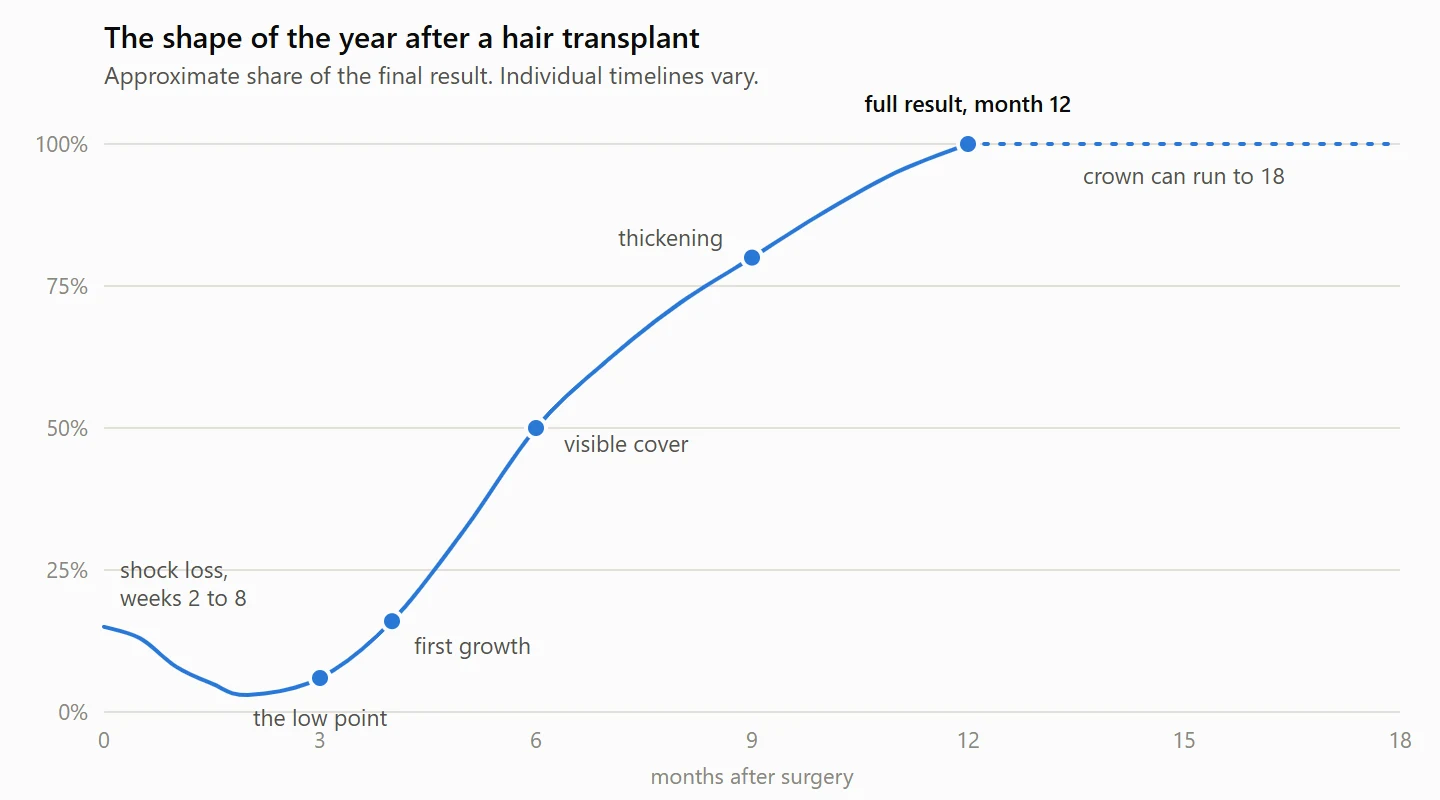
Count on three markers: month 4 for the first new hairs you can find with your fingers, month 6 for growth other people notice, month 12 for the result you judge. Between surgery day and month 4 sits a long quiet stretch where the work happens out of sight. The table below maps each checkpoint to a rough share of the final picture.
| Month | Approximate share of the final result |
|---|---|
| 3 | 0 to 10%; the low point, shedding just behind you |
| 4 | 10 to 20%; first thin hairs surface |
| 6 | Around half; visible cover, texture still maturing |
| 9 | Around 80%; density building, hairline settled |
| 12 | Full result for front and mid-scalp |
| 18 | The crown's finish line for slower cases |
The shares are approximate and each head runs its own schedule. A patient at 40% on month 6 and a patient at 60% can both land in the same place at month 12.
What happens in months 0 to 3?
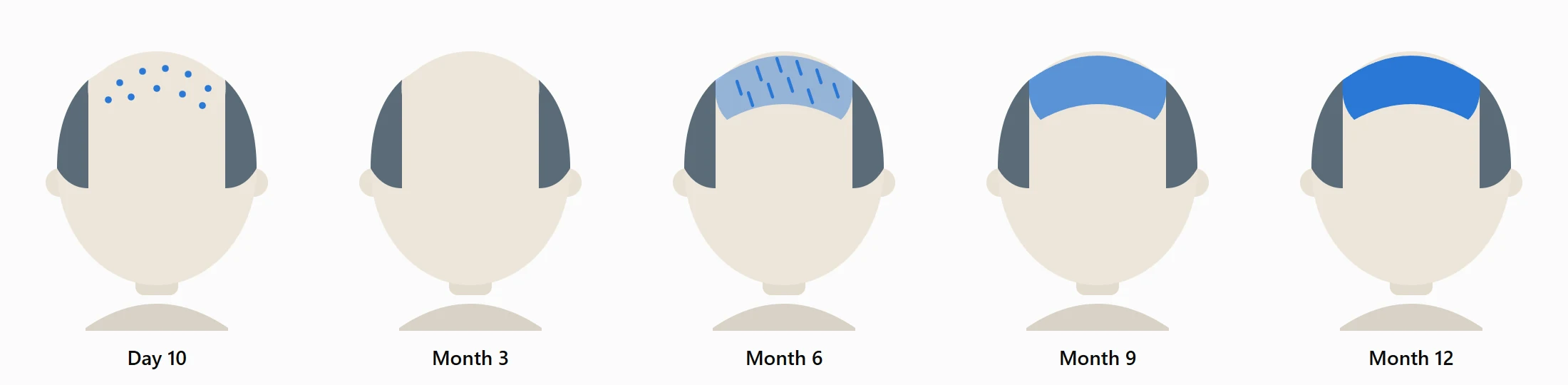
Months 0 to 3 are for healing and shedding, not growth. Week 2 closes the skin. Weeks 2 to 8 take back most of the short transplanted hairs, a phase with its own name and its own article: shock loss, what's normal and when to worry. The surgical literature describes this postoperative shedding as appearing a few days to a few weeks after surgery and as mostly temporary (Kerure and Patwardhan, Journal of Cutaneous and Aesthetic Surgery, 2018). By month 2 to 3 the zone often looks thinner than it did before surgery, and this is the stage that fills patient forums with worry.
Photograph these months for your records, but do not grade them. Nothing that matters can be read from a month 3 photo except that the skin healed well. A case report of two patients backs this up: biopsies from the shedding area showed follicles in a resting (telogen) phase with no inflammation around them, not follicles that had been lost (Annals of Dermatology, 2018). The daily rules for this stretch, washing, sport, sun, live in our recovery timeline.
When does new hair start to grow?
New hair starts to grow around month 4. Fine, soft hairs surface across the grafted zone, often patchy at first, sometimes curly or wiry in a way your hair never was. Both are temporary. New follicle output starts thin and coarsens over the following months, and uneven timing between zones is the norm, since follicles wake on their own clocks.
Month 6 is the milestone most clinics ask to photograph. Cover exists, the hairline reads as a hairline, and styling starts working again. It is also, on the numbers, only about the halfway mark.
Why is my hair still thin at 5 months?
Because month 5 sits in the thin middle of the curve: roughly a third of the final density, made of hairs at their thinnest caliber. Two separate things still have to happen, more follicles joining in and every strand thickening. Both are scheduled for the months ahead. Thin at 5 is the plan working, not failing.
When does the hair get thicker?
The hair gets visibly thicker between months 7 and 9, when cover turns into density. Strands gain caliber, the wiry texture of the early growth relaxes toward your native hair, and the see-through quality under strong light fades. Somewhere in this stretch is usually the moment a colleague who knew nothing asks what changed. By month 9 around four fifths of the result is on display.
When is the final result visible?
Month 12 is grading day for the front and mid-scalp: density is in, texture matches, and what you see is what the surgery produced. The crown follows a slower calendar and can keep filling to month 18, which is why crown patients are told to wait before drawing conclusions. Serious clinics schedule the full photo review here and only now open any conversation about touch-ups.
Do results keep improving after 12 months?
Texture and the crown, yes. Density elsewhere, no. Strands keep maturing and the crown keeps filling into the eighteenth month, but new follicle activity at the front is done at 12. A front that disappoints at 12 will not be rescued by month 15, which is exactly why 12 is the honest checkpoint for judging the work.
How do you judge your own progress?
The only fair comparison is your own head against your own head, in matching frames. Monthly photos, same room, same light, same angles, dry hair. Bathroom lighting from above is the harshest judge a scalp has, and wet hair makes density look much lower than it is, which is why the mirror after a shower regularly causes panic that a proper photo dissolves.
Send the milestone sets, months 3, 6, 9 and 12, to your clinic whether they ask or not; the ones with scheduled reviews will ask. In our database, 77 of the 100 clinics list aftercare in their package, but what that covers varies widely, so ask before you book whether it includes a 12-month photo review. If something in the pictures worries you, the normal versus see-a-doctor table in our shock loss guide separates routine from reportable. And measure against expectation, not against marketing: a result is judged on the graft count that was planned, the density that was agreed, and the photos taken at 12 months.
The Bottom Line
The year splits into four acts: a quiet, discouraging opening quarter, first growth from month 4, thickening through month 9, and the finished picture at 12, crown excepted. Photograph monthly, judge at the milestones, and let nothing before month 4 scare you and nothing before month 12 flatter you. The daily rules live in our recovery timeline and our treatment pages explain how FUE, Sapphire FUE and DHI differ. When you choose a clinic, our ranking of the best hair transplant clinics and Compare All Clinics filter the 100 clinics we review by city, price and technique.
Sources:
- Kerure AS, Patwardhan N. Complications in Hair Transplantation. Journal of Cutaneous and Aesthetic Surgery, 2018;11(4):182-189.
- Loh SH, Lew BL, Sim WY. Localized Telogen Effluvium Following Hair Transplantation. Annals of Dermatology, 2018;30(2):214-217.
FAQ
What should a hair transplant look like after 1 month?
Healed skin, fading pinkness, and less hair than you hoped, since shedding is underway. A clean, calm scalp is the whole checklist for month 1. Growth is not on it.
How long do hair transplant results last?
The grafts are taken from the donor zone precisely because its follicles resist the hormone that drives pattern loss, so transplanted hair is built to stay for decades, usually for life. What can change the picture is the native hair around the grafts continuing to thin, which is why many patients stay on finasteride after surgery.
What percentage of grafts survive?
Clinics often quote graft survival of 90% or more, but the real figure depends on handling speed, storage and implantation technique, and it is rarely measured independently. That is one more reason team quality outweighs technique branding.
How can I maintain or improve the result?
Protect the native hair, since the grafts look after themselves: finasteride or minoxidil where prescribed, and a clinic review if native thinning accelerates. Nothing sold as a growth booster changes what the follicles were going to do.
Why do clinic before-and-after photos look better than my mirror?
Photography favours the result: styled dry hair, soft frontal light, chosen angles. Your bathroom does the opposite. Compare your month 12 photo with your before photo under matching conditions, and only then with anyone's gallery.
When should I talk to my clinic about a touch-up?
At month 12, with the full photo series in hand, or month 18 if the crown is the complaint. Earlier conversations price work the follicles may still be planning to do for free.

Elif Yıldırım
Covers the patient side of a hair transplant in Turkey: recovery, aftercare and the questions worth asking a clinic before booking. Fact-checks each article against our clinic database.