

Hair Transplant Recovery Timeline: Day 1 to Month 12 (2026)
Last updated: September 2026
Quick answer: The skin heals in about 2 weeks, the grafts anchor within 10 days, and the cosmetic result takes 12 months. In between sits a shedding phase that alarms almost everyone and harms almost no one. The timelines below are standard practice across the market; where your clinic's protocol differs, its protocol wins. Our Methodology explains how we compile clinic data.
How long does hair transplant recovery take?
Hair transplant recovery takes about 2 weeks for the skin, 7 to 10 days for the grafts to anchor and 12 months for the final result, up to 18 for the crown. Three clocks run at once, and mixing them up causes most of the panic. Visible healing, meaning the crusts and the redness, wraps up in roughly two weeks. Grafts need 7 to 10 days to lock in, which is why the strict rules sit at the start. The result you paid for arrives on the slowest clock, which is why nothing should be judged before month 12.
| Phase | Timeframe | What is happening |
|---|---|---|
| Graft anchoring | Days 1 to 10 | Grafts fix into place; the do-not-touch rules exist for this window |
| Skin healing | Days 1 to 14 | Crusting appears then clears, the pink tone settles, the operated look fades |
| Shock loss | Weeks 2 to 8 | The new hairs shed while their roots hold on |
| Regrowth | Months 4 to 12 | New hairs emerge, thicken and mature to the final result |
What happens in the first week after a hair transplant?
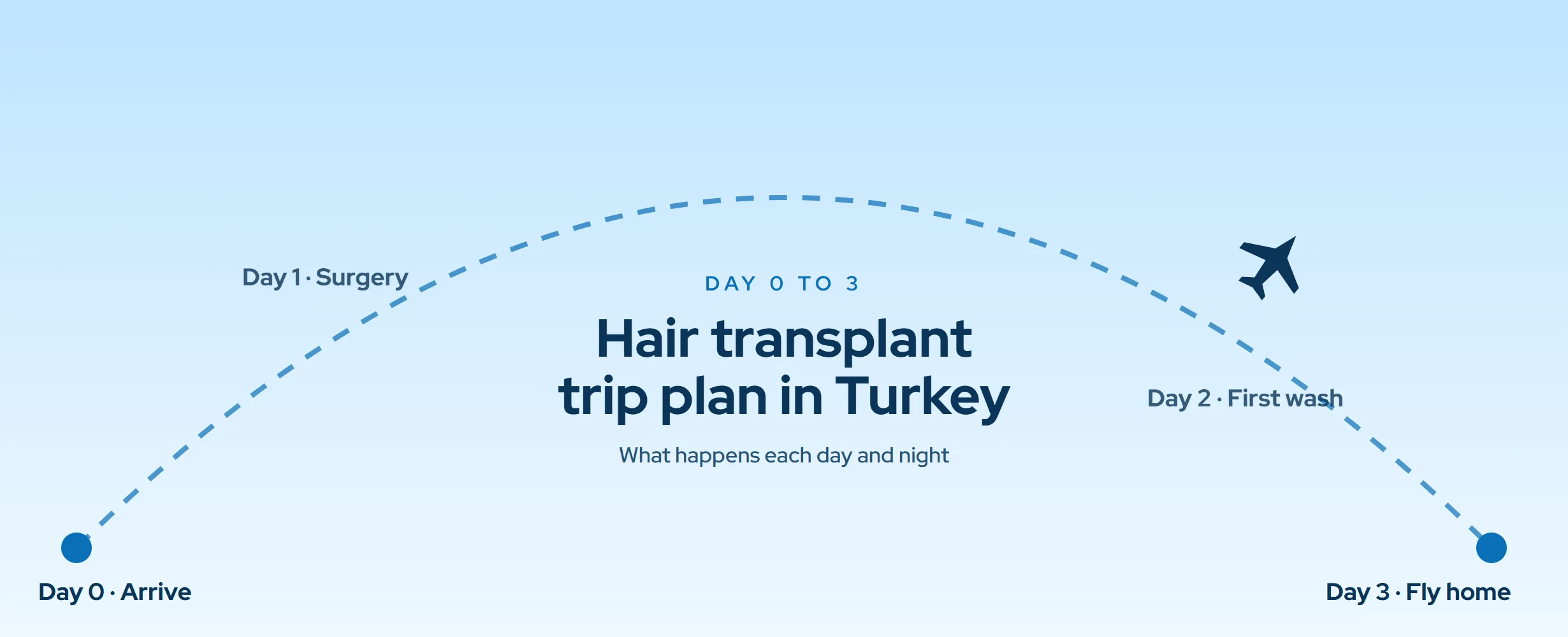
Week 1 is protection mode: the grafts are anchoring, so the scalp is washed gently, slept on carefully and otherwise left alone. The first three days belong to the trip itself: bandage check, the first wash at the clinic, clearance to fly. Our Day 0 to 3 trip plan covers them hour by hour. From Day 4 you are on your own, at home, washing daily with the foam and lotion technique the clinic taught you: no water pressure on the grafts, no rubbing, patting only.
This week the scalp is simply healing, and it looks like it. Light scabbing over the graft area, some pinkness, mild swelling that can drift toward the forehead around Days 3 to 5, and itching as the skin recovers. The donor area mostly feels tight for a few days while it closes. All of it is expected and none of it says anything about the result.
How should you sleep after a hair transplant?
Back sleeping, upper body raised to about 45 degrees, a U-shaped travel pillow holding the grafted zone clear of the bedding. Most clinics want 7 to 10 nights like this before normal positions come back. The point is simple: a graft that gets rubbed against fabric in week one can be lost, and sleep is the longest unsupervised contact your head has with anything.
Where clinics differ in week 1:
- Washing frequency and product: some protocols wash daily from Day 3, others every other day. Follow the sheet you were given, not a video from another clinic.
- Sleep duration advice ranges from 5 to 10 nights propped. When in doubt, ask for your number in writing.
Week 2: Scabs fall, rules loosen
When do the scabs fall off?
Between Days 10 and 14, and the wash is what removes them. From around Day 10 most clinics switch you to a slightly firmer washing motion, gentle circular rubbing with the fingertips, so the softened scabs lift away. Clearing them inside this window matters: skin free of scabs lets the new hairs come through. Two things stay off the table the whole time, working on them before Day 10 and using fingernails at any point. Fingertips in the wash do the job.
Once the scabs are gone, the surgical look goes with them. Redness keeps fading over the following weeks, and by the end of week 2 most people pass in public without a second glance. The rules loosen in step: normal shampooing returns, light exercise restarts, and a loose, clean cap becomes acceptable at most clinics for sun and social cover.
When can you go back to work, sport and normal life?
Desk work within 2 to 3 days, light gym at 10 to 14 days, heavy lifting and the sea at about a month. The table gathers the standard deadlines in one place. Every one of them assumes normal healing, and your clinic's version overrides this list.
| Activity | Earliest return | Note |
|---|---|---|
| Desk work | 2 to 3 days | Scabs visible; camera-off is your friend |
| Physical work | 10 to 14 days | Sweat and helmets both wait; heavy lifting on the job waits 3 to 4 weeks |
| Walking | Immediately | Keep it shaded and easy in week 1 |
| Light gym, cardio | 10 to 14 days | Start light; sweat stings healing skin |
| Heavy lifting | 3 to 4 weeks | Straining raises pressure in the scalp; ask your clinic for its number |
| Running | About 2 weeks | Once the crusting has cleared |
| Swimming, sea, pool | About 4 weeks | Chlorinated and salt water both bother healing skin, and sun on top makes it worse |
| Sauna, hamam, steam | About 1 month | Heat widens blood vessels and keeps the scalp pink longer |
| Direct sun | Protect for 2 weeks, careful to month 3 | A loose cap outdoors after Day 10 to 14, sunscreen once the skin closes |
| Haircut | Scissors at 3 weeks, clippers on the donor at about 1 month | The recipient area waits longer for clippers |
| Hair dye | About 3 months | Chemicals on healed skin only |
| Alcohol | About 1 week | It thins the blood and can add to the swelling |
| Smoking | At least 2 weeks | It cuts blood flow to the grafts; longer is better |
| Sex | About 1 week | Sweat and accidental contact are the issue, not the activity |
Why does transplanted hair fall out? (Months 1 to 4)
Transplanted hair falls out because it is supposed to: between weeks 2 and 8 the majority of the newly placed hairs let go. What stays put is the follicle itself, the growth engine under the skin; what you lose is only the visible strand. This is shock loss, it is expected, and it is the single most common reason patients panic and email their clinic at week 4.
What follows is the ugly duckling phase. Around months 2 to 4 you may look thinner than before the surgery, since some native hairs shed too and the new growth has not started. This is the stretch where aftercare quality shows. A clinic with scheduled photo reviews tells you at month 3 that everything is on track. A clinic whose plan was "message us if something happens" leaves you to compare your scalp with forum photos at 2am. That difference is worth checking before booking. Aftercare is listed in 77 of the 100 packages we track, but the word covers anything from a follow-up schedule to a WhatsApp number, and only 9 of the 69 clinics in our Transparency Index publish written guarantee terms. Ask for the follow-up schedule in writing; our Best Hair Transplant Clinics ranking scores aftercare as one of its criteria.
When will I see the final result? (Months 4 to 12)
New hair starts at months 4 to 6, thickens visibly at 6 to 8, and the result is final at 12 months, up to 18 for the crown. The regrowth is quiet and gradual, and it follows a fairly predictable rhythm:
- Months 4 to 6: the first permanent hairs break through, thin and sometimes curly or wiry. Texture normalizes later.
- Months 6 to 8: visible thickening. This is usually when other people start noticing, and the halfway photos most clinics request get taken.
- Months 8 to 10: density builds, the hairline settles into its final shape, texture matches the rest of your hair.
- Month 12: the result is considered final for the front and mid-scalp. The crown is the slow zone and can keep improving to month 18.
Judge the result at 12 months, not before. Serious clinics do not discuss touch-ups or revisions at month 6, because half the growth has not arrived yet.
What is normal and what needs a doctor?
Itching, small bumps, numbness and uneven early growth are normal; spreading redness, discharge, fever or increasing pain need a doctor.
Normal and expected during recovery:
- Itching that peaks with healing and eases after the scabs fall
- A few pimple-like bumps as new hairs push through, single and scattered
- Numbness in the donor or recipient area fading over weeks, occasionally months
- Uneven early growth, one side ahead of the other
Contact a doctor, your clinic first, promptly for:
- Redness that spreads, feels hot or throbs after the first days
- Discharge or a bad smell from any part of the scalp
- Fever
- Pain that increases instead of fading
The first list is biology. The second list is the short set of signals covered in the risk section of our safety guide, and acting on them early is what keeps small problems small.
The Bottom Line
Recovery is front-loaded: ten careful days protect the grafts, two weeks close the skin, and after that the job is patience through a shedding phase that looks like failure and is not. Photograph your scalp monthly, follow your clinic's sheet over anything you read online including this page, and judge nothing before month 12. For what comes before the surgery, our 2-week preparation checklist covers medications, alcohol and tests, the Day 0 to 3 trip plan covers the trip itself, and Compare All Clinics filters the 100 clinics we review by city, price and technique.
FAQ
How painful is hair transplant recovery?
Most patients describe the first 2 to 3 days as sore and tight rather than painful, mostly in the donor area, and the painkillers the clinic prescribes usually cover it. Swelling peaks around Days 3 to 5 and then fades. Pain that increases instead of easing is a reason to call the clinic, not to wait.
When can I wear a hat after a hair transplant?
Many clinics allow a loose, clean cap from around Day 10, after the crusting clears, as long as nothing rests on the grafted zone. Fitted caps, helmets and anything that presses wait about a month. Ask your clinic for its exact day, and put the hat on and off carefully, from the back forward.
When can I sleep on my side again?
Usually from night 7 to 10 onward, when the grafts have locked in. Earlier side sleeping risks the grafted zone rubbing the pillow. If you wake up mid-week on your face, do not spiral; anchored grafts after Day 5 tolerate brief contact far better than Day 2 grafts.
How long until a hair transplant looks normal?
Socially normal at about 2 weeks, when scabs are gone and redness has faded enough to pass unnoticed. Cosmetically finished at 12 months. In between sits the months 2 to 4 dip, when shedding makes things look worse before the regrowth arrives.
Does everyone get shock loss?
Most patients do, to different degrees, and its absence is not a problem either. Shedding intensity says nothing about the final result. The follicles decide that, and they stay in place either way.
When can I use minoxidil or styling products again?
Minoxidil usually restarts 2 to 4 weeks after surgery, with the clinic's approval, on healed skin only. Gel, wax and spray wait until the scabs are fully gone, then keep them off the graft zone for the first weeks and wash them out daily.

Elif Yıldırım
Covers the patient side of a hair transplant in Turkey: recovery, aftercare and the questions worth asking a clinic before booking. Fact-checks each article against our clinic database.
