Shock Loss After Hair Transplant: What's Normal (2026)
Last updated: September 2026
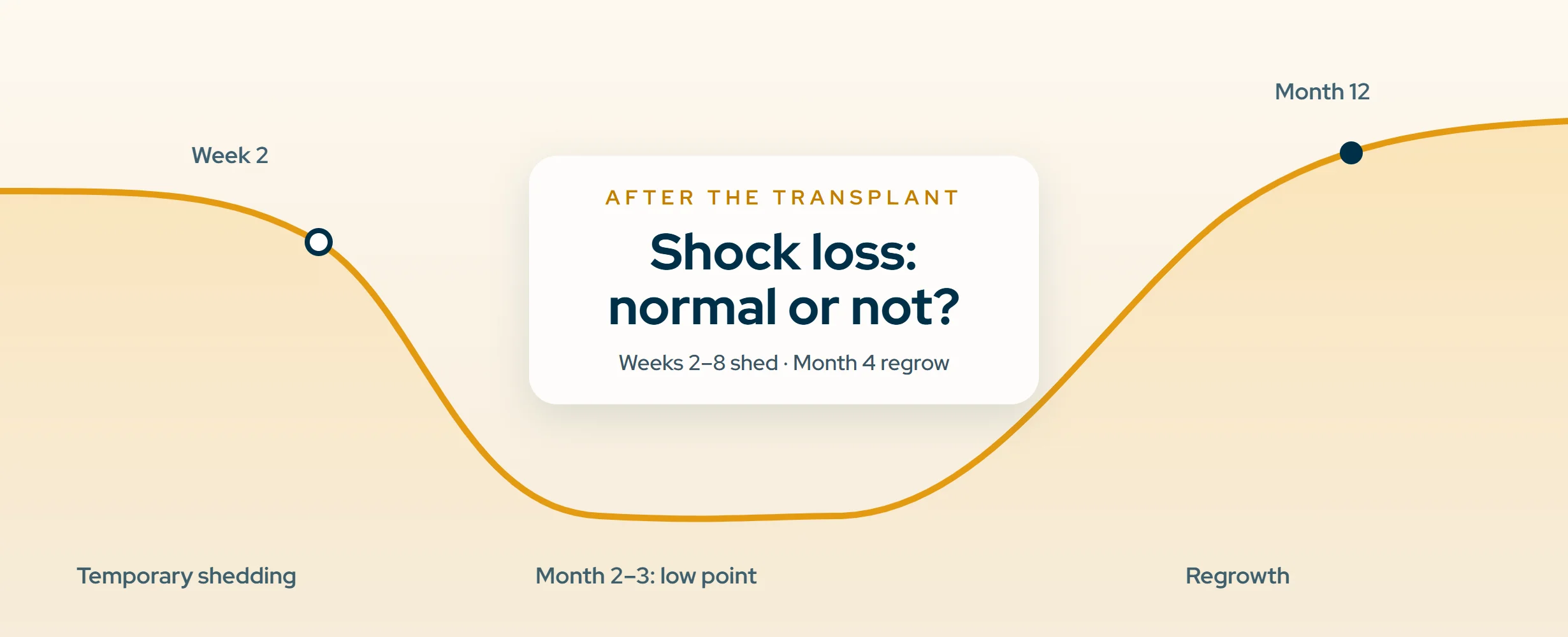
Quick answer: Hair falling out 2 to 8 weeks after a transplant is, in the great majority of cases, shock loss: the strand drops, the root beneath it stays and rebuilds. Shedding peaks around weeks 4 to 6, the area looks thinnest in months 2 to 3, and new hair starts to appear from month 3 or 4. Nothing about your end result is decided in this phase. Further down sits a short list of signs that separate routine shedding from something a doctor should see. Our Methodology explains how we compile clinic data.
What is shock loss after a hair transplant?
Shock loss is the temporary shedding of transplanted hairs, and sometimes of the native hairs around them, in the weeks after surgery; the follicles stay alive and regrow within a few months. Surgery is rough on a scalp, and follicles answer roughness the same way every time: they pause. The anaesthetic, the opened channels and the briefly disturbed blood flow tip them into a rest state, and a resting follicle lets its strand go. Underneath, the root keeps living and restarts production a few months later. The pause can catch native hairs near the grafts as well as the grafts themselves, which is why the thinning often spreads past the borders of the work.
What does shock loss look like?
Overall lower density rather than holes. Short new hairs drop from the grafted zone, neighbouring hair may go a little sparse, and the whole area reads as a faded copy of itself. Clean, round bare spots tell a different story and sit in the worry list further down. A note on image searches: the pictures people upload come from the lowest weeks, roughly 4 to 8. Nobody photographs month 12 to illustrate shock loss.
When does shock loss start and stop? The timeline
Count 2 to 4 weeks from surgery to the first fallen hairs, a peak around weeks 4 to 6, calm again by week 8, and fresh growth pushing through from month 3 or 4. From the first lost strand to the first new one: about a quarter of a year.
| Period | What happens |
|---|---|
| Weeks 1 to 2 | Quiet; the skin is busy closing |
| Weeks 2 to 4 | The first strands let go |
| Weeks 4 to 6 | Heaviest shedding; clinics get their most worried messages now |
| Weeks 6 to 8 | The wave dies down |
| Months 2 to 3 | The thin stretch; the visual low point |
| Months 3 to 4 | New growth surfaces and the cycle is done |
Give or take a week or two per person. The pattern is the diagnostic part: a single rise, a single fall, then regrowth. For where this sits inside the whole healing arc, our recovery timeline runs month by month to the finished result.
Is shock loss permanent?
Not for the grafts. Their follicles sit anchored under the skin and push out a replacement strand in due course. Native hair mostly returns too, with one exception worth stating plainly: strands that were already miniaturising under ordinary pattern loss sometimes use the shock as their exit and stay gone. The operation did not destroy them; it brought a scheduled departure forward. That is a key reason surgeons like patients to stay on finasteride through this period, since the drug steadies precisely those fragile neighbours.
Does everyone get shock loss?
Nearly all patients see some of it, a lucky few see none, and the spread between mild and dramatic is wide. A shed so light you barely register it and a shed that empties the zone both sit inside normal. Intensity predicts nothing in either direction: a rough shed does not foreshadow a weak result, and a missing shed does not mean the grafts failed to take. Until month 4 the follicles work invisibly, whichever camp you land in.
Does the donor area get shock loss too?
It can, and this version gets less attention. Hair around the extraction sites sometimes goes sparse for a while, filling back in over 2 to 4 months. Same trigger, same temporary nature, different area.
One distinction carries real weight here. Donor shedding grows back; a donor zone stripped of too many grafts does not. Sparse, patchy donor hair still hanging on past months 4 to 6, particularly after a big-number session where no doctor was ever named, is worth an outside opinion. What overharvesting is and how to screen out the clinics that do it is covered in the donor section of our guide on whether a hair transplant in Turkey is safe.
What's normal and when should you contact a doctor?
Shedding by itself, inside the window above, is routine; shedding with skin trouble, or thinning that outlives the calendar, needs a professional look.
| Situation | Normal? | What to do |
|---|---|---|
| Hairs on the pillow and in the shower, weeks 2 to 8 | Yes | Weekly photos for your own file, nothing else |
| The grafted zone empties out almost fully | Yes, in the peak weeks | Sit tight; the roots are working under the surface |
| Thinning reaching past the operated area | Yes, neighbours join in | It returns with everything else |
| One side ahead of the other | Yes | Symmetry is the exception, not the rule |
| Month 3 looking worse than the before photo | Yes, the low point | The verdict date is month 12 |
| Shedding plus spreading redness, discharge or pain | No | Message the clinic the same day |
| Clean bare patches on unhealthy-looking skin | No | Clinic first; a dermatologist if nobody answers |
| Loss still gathering speed past month 4 | No | Book a review; another cause may be in play |
| A sparse donor patch outlasting months 4 to 6 | No | Get the donor assessed, elsewhere if necessary |
Your clinic sees it first, in photos taken in the same light each time. Where scheduled photo reviews exist, this whole worry resolves in one reply. Where they do not, and days pass in silence, the next stop is an independent dermatologist rather than a forum thread. Follow-up is one of the things worth comparing before you book; our ranking of the best hair transplant clinics weighs aftercare as one of its criteria.
Can you prevent or reduce shock loss?
Not completely, and a clinic promising a shed-free recovery is overselling. What can help:
- The aftercare sheet, followed to the letter through the anchoring days, washing and sleeping above all
- Finasteride, continued if already in use; it steadies the fragile native hairs nearby
- Minoxidil or PRP where your clinic prescribes them, on its schedule, never self-started
- No cigarettes through recovery, because follicles live off what healing tissue feeds them
No technique has been shown to prevent shedding. FUE, Sapphire FUE and DHI all involve the same kind of trauma to the scalp, so all of them can cause it; our treatment pages explain how the techniques differ in other ways. Shampoos and supplement bundles marketed as shock loss protection have not been shown to prevent it in clinical studies, so ask your surgeon before buying them.
The Bottom Line
Shock loss is part of the process: strands drop between weeks 2 and 8, the mirror bottoms out around months 2 to 3, and new growth appears from month 4. The roots hold through all of it, and month 12 is when results get judged. Save the worry for the short list: skin symptoms, clean bare patches, loss still increasing past month 4, a donor area that does not fill in. The full healing arc lives in our recovery timeline, and screening clinics before any of this begins happens at Compare All Clinics, filtering the 100 clinics we review by city, price and technique.
FAQ
How much shedding is too much after a hair transplant?
Quantity misleads; timing and pattern inform. A startling number of hairs at week 4 can be entirely routine, while modest loss still increasing at month 5 is not. Measure against the timeline, not against the shower drain.
Can shock loss happen twice?
One wave is the norm. A shed that ends, then returns and builds months later has probably stopped being shock loss and deserves the clinic's or a dermatologist's attention, since ordinary pattern loss or a separate scalp condition may have taken over.
Is shedding at month 4 still shock loss?
It is an edge case. A slow tail of shock loss can reach month 4, but that month belongs to regrowth, not to fresh loss. Book a check instead of waiting another three months.
Does shock loss mean the transplant failed?
No. A failed transplant shows itself as missing density at month 12, never as shedding at week 4. The early drop is part of the normal process; the grafts show what they can do from month 4 on, as the new strands arrive.
Should I massage or rub the area to stimulate regrowth?
No. Early on, rubbing endangers exactly the grafts you are anxious about. Later, it adds nothing the follicles had not already planned. Put the impatience into monthly photos, same light, same angle.

Elif Yıldırım
Covers the patient side of a hair transplant in Turkey: recovery, aftercare and the questions worth asking a clinic before booking. Fact-checks each article against our clinic database.